Defeat

Defeat is a funny thing. It stirs all emotions in me from anger, to gratitude to humility to humiliation. I can say that I have turned away from more summits that I have actually achieved. Either it was too dangerous, or I was too weak (mentally, physically, emotionally). Of course, in the moment, I blame it on the weather, snow condition, gear… Never on me. Of course, it wouldn’t be me. Especially if it a peak I have trained for and planned for. Something I prepared for long and hard, put it together and still came up short. Of course, that wouldn’t be my fault. But usually, it is. That’s a blow to my ego, to my story that I am a hero, a man’s man, and that I should be able to do anything I set my mind to.

Today I received such a blow. I didn’t make a summit that I had planned for, worked years on preparing for, one I felt ready for. This wasn’t a physical summit, but a mental one, a test. One that I was sure I would pass. As a matter of fact, one that has a national passing rate of over 90%. Surely, I wasn’t one of the 10% that wasn’t going to fail. But I did. I am. I was shocked. I was in disbelief; first stage, right?

So what’s it mean? What do I do now? Did I prepare the best I could, and is that enough? Clearly the test creators say it isn’t enough, which means, I’m not enough. Right? Isn’t that what this test is trying to show?

I feel sad, but also numb. I was angry. So angry in fact, I thought I would break my hand punching the innocent car dashboard. Was I angry with the car? Ha, no. Was I angry with the test? Come to think of it, it wasn’t me that failed the test, the test was crap. The questions weren’t fair and I had the right answers, even if they were marked wrong. All of that, of course, is a lie. I was angry with myself. Angry that I somehow missed the mark.

Once the anger had passed, I realized that I wasn’t angry. I was sad. There was a lot hanging on this test, and I blew it. Now what will happen to my plans? What will I tell my friends and family? How will I tell my wife that the last 7 years built up to this point, and I failed? I thought maybe I could bribe someone to nudge me over the mark. Maybe I could make a deal with someone. Can I call and get an official to go over it?

Then I realized. I’m not angry. I’m not sad. I am scared, terrified. Does this mean I am fraud? Maybe. I have to be willing to admit that I am not who I think I am (the man I hope I am). Maybe I am less of what I think, not as smart or as funny or as … anything… as I thought. Maybe this is the moment when we really see the man behind the curtain, and maybe that man isn’t really a man. I’m scared that I don’t have what it will take to make it if I can’t pass an entry level exam. I’m scared that, even though I felt like I knew the material, I had prepared and worked hard, I still don’t have what it takes.  I have to be willing to accept it, even if I don’t think that’s the case.

I have turned away from more summits that I have been on top of. That doesn’t stop me from climbing as high as I can, enjoying the climb along the way, and returning another day to reach the top. So, I was slapped down today, hard. It hurts. I want to sit and cry about it, and for a moment I have. But at the end of the day, I need to stand up, strap on my pack and start climbing. Right now, it hurts and I don’t know how to do it any better, but… time to get up. Let’s keep climbing.

Take away love and our earth is a tomb

She is a woman of some, never before -or after- seen, power. Her thoughts and mind, her body and soul, but most of all the love. Not, per se, the love she has for me, but what I felt for her. For it is only my feelings I can be sure of. My feelings are the only thing that is real in this dream I call “life”. My feelings: the only thing that’s real.

Could the love I feel been created and placed in me from a higher power other than my own? Maybe it’s a feeling she gives to me, because of who she is. Perhaps it is a creation I make in the abyss of my own heart. In any case, the feeling is more powerful than death, more fragile than life.

She has some special way to hypnotize you as you lost yourself in her thoughts. Not only does she make me want to be the best, she makes me want to be a servant as well. Not to grovel or be weak; quite the opposite. Simply, to serve out of love and honor. And the honor is mine. Her mind encourages freedom and liberty. Freedom from the line of stagnant concentration, and liberty from the edicts established by society. She lives outside ‘the box’, most of the time. Living outside ‘the box’ but wishing for the strange freedom the ‘box’ provides.

I do not try to compete with the depth of another; meditation should have no competition. However, I strive to be able to understand the emotion behind the thoughts of others. Understanding the emotion someone has for the thoughts they have created, or adopted, or interpreted creates respect. She, and everyone for that matter, does what she deems just. Not necessarily right or wrong, but just. We all justify our actions. Hence, understanding the emotion behind that, one can gain respect for even the harshest of Tyrants.

Like many of the old souls, she provides a well of wisdom. It is difficult to find a person whose soul can match the depths of your own. Then once found, difficult to understand. For understanding yourself is true enlightenment, which so precious few have ever accomplished. Therefore, understanding a soul deep as your own would bring you to the doorstep of self-knowledge, or even the hallowed enlightenment. Like a block of marble can be formed into a beautiful sculpture, thoughts -once refined- could be works of art.

Now, once you have discovered the depth of the soul of another, if it be unequal, it is bearable to defeat the relationship. However, if it be equal, or even greater, there is little hope disarming that ruler. Perhaps because we may finally find the answer we seek in ourselves, in others. Maybe we have found it so difficult to look inward, we turn to find an easy answer. Perhaps, we can find what part we think is missing in our self, in the soul of someone else. The irony is: we are born whole and perfect. We contain every part of a perfect being. That answer just seems so much clearer looking into someone else’s eyes.

Let me not speak of her beauty for she is as pretty as a song. As many flaws as she may carry, they will forever be surpassed by her charm and charisma. People like her, and she likes that. When someone may show a sign of disdain towards her, she works wonders to change ebb of that tide.

Why do we find it necessary to fall (though we do not ‘fall’ into love? We chose very deliberately to place our hearts there. Even more importantly, we choose to leave it there, or steal it back.) into relationships? Why do we place people on pedestals throughout our life? I believe it contributes greatly towards a person’s moral and intellectual health to be brought into habits of companionship with individuals unlike themselves. Who care little for their pursuits, and whose sphere and abilities they must go out of themselves to appreciate. The confirmation of our true selves, the companionship of another, the knowledge gained and the belief that another can love us more than we love ourselves, are all major factors. When we are born, we need others so badly to survive. Without constant attention we would fall before the scythe of the Grim Reaper. At death we often fall into needing others care. Ability having escaped our now fragile body, we stand again in need of a loving soul to care for us. In the middle of life and death, it seems we need people most of all.

We are beautiful, we are whole. The truth is, we need others; they need us. We need to be more generous, more understanding, more loving. Our souls are so fragile, and we are so clumsy. It is with a lot of love that we all will move forward through the dark and dreary. “Take away love and our earth is a tomb.” -Robert Browning

from an ER nurse

A dozen things I wish you knew.

There’s lots nurses wish they could say, but can’t; either because we are afraid of hurting your feelings, or losing our jobs. So let me write this without actually putting my name on it in hopes that I don’t get a fiery brown bag full of poop on my doorstep from you or my boss.

Let’s be honest, the healthcare industry is jacked. Part of the SNAFU is the public’s demand for customer service in healthcare and the concept that healthcare is a right instead of a privilege. Here’s the thing, healthcare is a limited resource – we like to think it isn’t but it is. AND, People expect nurses to do all kinds of terrible things and at the end of the day say, “Geewiz, what a great opportunity I have to do this.”

Now, let me be clear: I love my job, love it. I am excited every time I get to go in. I get to work with some of the best doctors, nurses, techs, RTs, PAs, NPs, housekeepers, volunteers, administration, HUCs, housekeepers and on and on. I am one of the nurses who really does say, “what a great opportunity…” However, that doesn’t mean I am blind to the ridiculousness of the healthcare industry both from our end (the provider’s) to your end (the patient’s) and the man (government) in between.

Anyway, here are a dozen things I have put down hoping that it may help you understand a little more about my day-to-day. Next time you think, “Should I go to the ER?” I want you to think about this list. Read it. Stop and say, “do I really need to go to the ER?” If you do, come on down and let us take care of you. If you don’t really need to, go to your family doc and hash it out there.

  1. Your doctor may be incompetent. Although I work with some of the best doctors around, I have learned that doctors (of every flavor from family practice to surgeons to specialists) are like chefs. Some are great and make a five-star meal from items found in a bachelor’s fridge. Others can’t boil water without ruining it. So, ya. Your doctor, or the doctor we turn you over to may be an excellent one, or a crappy one. All the same, I can’t tell you more than, “you’re in excellent/good/great/wonderful hands,” because I will get fired if I tell you the truth and say, “I wouldn’t let him touch my dog.”
    Along this same line, your life is in my hands, not the doctor. In other words, the doctor didn’t save you, I did. Ever notice how often the doctor takes credit (or how often you give him credit)? Behind the scene it may have been me there telling the doctor, “Hey, they don’t look good, can I…” or it was me that performed the duties that resulted in your recovery. Sure, credit where credit is due, the doctor gave the order; but who wins wars, generals or soldiers? Food for thought.
  2. I am often a translator from doctoreese to English, ask me what he just said if you didn’t understand the doctor. He/she speaks a different language to make himself/herself sound pretty cool, and guess what, they do sound cool. They are cool and they worked hard to become that cool, but man, it’s not cool when we can’t understand it. I have had several patients nod idiotically at the doctor while he/she was explaining results/procedures/ect. After the doctor leaves, the patient turns to me with that stupid blank stare and says, “what the hell did he just say?” Thing is, you should ask questions, you should ask for it to be watered down to a level you understand. Physicians spent around a decade trying to become a well-versed provider. Nurses spent at least 3 years, in school, learning how to do their job. Part of their job includes translation. So ask, please. It makes us (nurses) feel better about you and your care. When you don’t ask, I assume you’re not getting it and don’t care.
  3. You’re a moron. WebMD, Google, Wikipedia, or any other internet source can’t diagnose you, and if they do, they’re probably wrong. The internet is great, and gives us TONS of information. BUT, it’s not always right, and often causes more drama than not. Here’s the thing, you should question your care, we should have answers. But don’t think, just because you read it online, you suddenly know – you don’t. And while I am on this tangent, no, vaccines do not cause autism!
  4. If I walk in your room and you’re playing on your cell phone, you’re pain isn’t that bad – it just isn’t. If you want to see pain, stand up, walk with me over to the Trauma bay and see the patient who was in the car wreck and did a superman through the windshield because he wasn’t wearing a seatbelt (btw: wear your seatbelt). Don’t get hung up on the pain scale. I will treat an 8 the same as a 6. I use the scale to understand if your pain is getting better or worse, not how much you’re suffering. Pain is subjective and I am taught to think, “pain is whatever you say it is” but if you’re telling me that you’re a 10 out of 10 but you’re falling asleep in the bed, guess what, I don’t believe you.
    This is a hospital full of people sick and dying, not a hotel (oh and also, the hospital is the dirtiest place to be, don’t let your kids play on the floor!). If you have come to escape the weather or lay in one of my beds, just think: The person who was in the bed before you had DIC and bleed from his eyes, nose, ears, penis, anus, and mouth until be bleed so much he died. Or it was someone who was covered in MRSA. Now… lay comfortably in the bed and rest. I’ll be right with you. Oh ya, come to think of it, that last patient complained a lot less than you, which brings to mind that the sicker you are, the less you complain.
    Then, when you do come, for the most part, don’t expect a cure from the ER. We send a lot of people home from the ER not totally sure what’s going on, you’re case may be no different. Roughly 65% of the abdominal pain complaints go undiagnosed, we don’t have a good answer for you, sorry. But what we do know is that it won’t kill you. That’s what the ER does; we find the things that will kill you fast and stop them, fast. If we don’t find anything, good news. However, I am shocked by the amount of people who get upset with me because we didn’t find anything. Hey, that’s good news man! You’re going to be ok. I know it’s frustrating that we can’t tell you why you hurt, but trust me, I would rather give you the news that you’re going to be ok, than tell you that you have cancer; that’s a crappy conversation, trust me.
  5. You’re abusing the system, and I am paying for it. We all know the Healthcare system is crap, and it may get worse. But when you treat the ER as your primary care center (your family doctor), you’re doing it wrong. For the most part, the people who do that are the people who don’t have insurance and have learned that the ER can’t turn anyone away until they have been seen, regardless of ability to pay. So who then will pay for the visit of the individual who comes in complaining of chest pain (btw it’s acid reflux = not an emergency) who called the ambulance who transferred the patient to the ER and after a $4000 work up and extensive nurse care? Me. I can explain why it’s me in the end, but really, I am paying for it. Yes, I get paid to take care of anyone who comes in and I get paid the same if you’re admitted to the hospital or sent home. But I don’t get paid what I am worth because the system is abused and is broken. I get it, but please, for my sake and sanity, don’t abuse the system. I don’t like it.
  6. I multiply how much you say you smoke/drink/do drugs by 3, that’s probably a little more accurate. What you do at home in regards to these items affects your care. Don’t lie! I can spot a meth addict, or someone high on heroin from a mile away. If I smell pot on your clothes and you say you never smoke, I am going to do a drug screen and call you on it. Thing is, I will find out what the blood alcohol and serum drug levels are, so just tell me so I don’t prolong your care. And yes, smoking is bad for you, so is drinking. So stop. On the subject of lying: your medical records (including the narcotics you’ve been prescribed) are computerized – don’t lie about it! If I, or the doctor, comes in and says, “Sorry I can’t give you any narcotics for the pain,” there’s a good reason…
  7. I spend more time charting on you than I do in your room with you so in case you sue I am covered. I am shocked that I spend twice as long on your chart than I do in your room with you. How terrible is that!? Shouldn’t I be in your room looking at you, assessing you, treating you? Instead I am at my desk charting about what I did in your room (my short visit). This is due to the feds, and to the people who have sued doctors, nurses and hospitals. So to offer protection to you, and ourselves, we have to chart… a lot! Sorry. I am not on Facebook. I am not checking my email. I am frantically trying to keep up on the charting, the orders, your demand for ice, and trying to plan my bathroom break.
  8. So what’s taking so long you ask? Let me explain… allow me to carry on to the idea that your emergency isn’t my emergency. I would love to be able to tell you about the patient next door who is having a heart attack, the other having a stroke and my fourth patient who is literally dyi… is dead. I am sorry I am late coming into your room to talk about your belly pain that’s been going on for several days. There is a process called, “running the board” that I would be happy to do with you at some point during your visit. This is when I go through all the other patients in the ER that are sicker than you, or who are dying faster than you are. Fact is, the ones who are going to die that fastest are the ones I pay most attention to. If I’m not in your room a lot, it’s a good sign about your health. Along that vein, if it’s been going on a while, the ER isn’t the palace to get it fixed. If you have been able to live with this for more than a day, you need to go to your family doctor and get it sorted out. The ER is for Emergencies. Emergencies are defined as “a situation that poses an immediate risk to health, life, property, or environment.” Immediate is the key word there. So consider, do you need to call 911 about the food poisoning you think you have from Taco Bell? And do you need to come to the ER about the toothache you have had since March? Seriously.
  9. I may look calm, but I’m freaking out. There have been a lot of times I have looked over the bed rail at my patient and thought to myself, “oh crap, she is dying… fast” but I have tried to keep the smile on. I want people to feel comfortable and at ease in my care. That’s hard to do if I look at them and say, “you’re looking bad, I’m not sure you’re going to make it.” So, if you see a calm nurse, it’s not because they have ‘easy’ patients, it’s because they have learned how to mask the freak out. But if you (as the patient) ask me, “have you ever done this before?” my answer is “Yes, I’ve done this before”, even if I haven’t. I know I am lying to you, but I wouldn’t do it if I didn’t feel like I could. The real scary life threatening stuff nurses can do, we always have a double check. So… ya. I can do it, even if it’s my first time. Chances are, I will succeed. I could fail…
  10. I may know more about your case than your doctor does, but I can’t tell you anything about it, and that’s a little frustrating for me, and for you. I have access to the same labs, xrays and documentation as the doctor and usually I see it before they do. That being said, I know (for the most part) what we are looking for, and therefore know what’s going on – sometimes before the doctor does. However, if you ask me, I have to say, “The doctor will read the results and make a plan with you about it.” It’s beyond my scope of practice to tell you about you. We call that a diagnosis and nurses aren’t supposed to do it. Ya… I know what’s going on, but I can’t tell you. There’s a funny (funny because it’s true) saying that goes something like this, “Do you want to talk to the Doctor in charge of your case, or to the nurse who knows what’s going on?” Truth in that statement.
  11. I may have forgotten about you, sorry. Don’t hesitate to hit the call light, that’s why I gave it to you. I don’t usually, but sometimes I do forget about you – or rather, the last time I saw you. Time really flies as a nurse, and you know how long you’ve been waiting to see me. I tried to give you a timeframe, but if you need reassurance, let me know. I will say, however, if you abuse that call light just because you haven’t seen me in 10 minutes and you need your pillow fluffed, or help finding the Disney Channel for your kid you’re letting play on the floor (I thought we went over that issue), I will rip the call light off the wall and only come see you when I have to. Don’t abuse me.
  12. I have feelings too and I may cry at home, or even at my desk, about you. I care, if I didn’t I wouldn’t do this job. I care that you’re in crisis, I care that you hurt and you don’t know what’s happening. I understand frustrations, and try my best to minimize them. When things are scary, or upsetting, I am happy to a shoulder to cry on, but I am not your punching bag. It tends to be the case that those who are kind to me, get kinder treatment. Be kind, it’ll come back to you. You should know that as a nurse, I sacrifice for you; nurses hold our bladders for hours at a time to make sure the charting on you is an accurate record of your care. We skip lunch breaks to make sure that your IV tubing is freshly changed so that it won’t cause you a blood stream infection. We kiss our children goodbye and assure them that Santa will still find them at grandma’s house on Christmas Eve, because daddy/mommy has to work night shift tonight. The long and short of it: Be nice or go away.


Sincerely, your ER nurse.


How Weird is Religion!?

I like to think that though my short years, I have learned a lot. But I one thing I know for sure is that I have a lot to learn.

One subject that has always been of interest to me is religions. God as a subject is interesting, but I find that the interpretation of man’s ideas about God are more fascinating. Why do people believe what they do? Why do they insist that their version of truth is THE version of truth? Isn’t truth universal, or is it a point of view? Where do people’s convictions come from, and why is your conviction better/stronger/more accurate than anyone else’s?

Beyond that, I find the study of religious traditions very interesting. Where did they come from? Why are they so strange to outside views?

In my opinion, a loving God (or whatever title you want to put there like, “energy”) has helped usher some of the major traditions in hopes of bringing as many of us near Him (again, don’t get hung up on titles here) as possible. Meaning: Imagine this, God sits back and says, “Boy, I know that I will get this group of people if I help them see the loving energy of the universe through the Buddha’s teachings.” Or, “I will give a perfect example in the poor carpenter who teaches love and peace.” Or even, “Man, the land here is tough and war stricken. I will guide this man to a cave and show him some truths that he can help bring millions closer to me in a religion that literally means ‘submission to God’.”

There are common threads through all religions, but the ones that strike a cord with me the most are the teachings of compassion, acceptance, love and tolerance. I love the concept of alignment with the force of the universe and submission to God. I adore the idea of a perfect example that is totally unobtainable for me, but somehow, I can be brought into.

One of the weirdest religions I have ever encountered is Mormonism (aka: The Church of Jesus Christ of Ladder-Day Saints). Full disclosure: I’m a member of this church, albeit not a very good  one – at least not by the main-stream definition. Not to say I don’t believe in the gospel the church preaches, or even to say I don’t try and live by the tenets of the church.

Mormonism caught a lot of publicity when the winter Olympics went to Salt Lake City, then again with all the media and news around Mitt Romney and Jon Huntsman. But wait, aren’t Mormons weird fanatics? Can we trust these cooks in high office?!

But when you actually look at religion, you really do have to ask. “Are Mormons any weirder than the rest of them?”

Really though. The question of allowing a high office to be held by a what-ever-religion-seems-weird seems to be a crazy question to me. Wasn’t this the same question that was posed to JFK, “Once a Catholic gets into the White House, the Pope will be running the country.” THAT is crazy to me.

Most of the folks I hear throw these questions out are my Evangelical brothers and sisters. Bear in mind, these are the folks who believe that a man, born of a virgin (um… how exactly? I practice in the medical field and I have yet to figure that out), was the son of God (THE God, like Thor or Hercules), only to die on a cross (a humiliating Roman torture method), and then be resurrected (like a zombie? a belief that is, with all due respect, not exactly the most rational belief either). But let’s take another group I have heard this debate from, the Orthodox Jews, who believe that the Red Sea split, a donkey talked to Balaam, and the sun stood still for Joshua. Did I mention there are unicorns, dragons and cockatrice in the bible? Ya, chew on that for a second.

Regarding Mormonism, the wise Rabbi Shmuley Boteach said, “Now, do I believe that Joseph Smith found ancient tablets written in reformed Egyptian in upstate New York, that Jesus Christ appeared to the people of South America as recorded in the Book of Mormon, or that when a Mormon dies he becomes a god and gets his own planet? No. Respectfully, I do not. Nor should it matter. It is what a person does, rather than what he believes, that counts. It took four years for the Dalai Lama to be identified as the reincarnation of his predecessor in a process that to Western eyes can appear highly arbitrary. Yet, the Dalai Lama remains one of the most respected men alive because of his commitment to world peace and good works.”

Here’s my beef: attacks on religion, any religion, stems from a willful desire to drive a separating wedge between people. These attacks usually begin with some fanatic that attempts to fraudulently identify different faiths as fanatics (ironic). I enjoyed several months of lectures on religion in Jena, Germany where the instructor would constantly say, “Look for the similarities that unite us, not the differences that separate us.” I took that to mean, “It’s cool if you think different, you look different or even smell different. But hey, look at all the ways we are the same. Be proud of being different, but embrace me in our similarities.”


Have you ever wondered why God commanded Abraham to sacrifice his son, Isaac? I mean, this is a fascinating legend that has so many lessons, but I think that the real message seems to elude the masses. Again from the insight of Rabbi Boteach: One of the most astute observations on this confusing story, comes from the Lubavitcher Rebbe, Rabbi Menachem Schneerson. Here he says that the key to the story is to see Isaac not as an individual but as a religion. AH! Think about who Isaac was… He represents Judaism. Isaac was going to continue the traditions of Abraham and in his death, everything that Abraham had learned and taught (think of the rejection of paganism and the belief in a singular God – thanks for monotheism!) would be lost.

So, like the ever-testing God of the Old Testament did, he tests Abraham. But the test isn’t “Would you kill your boy?” Rather, “Would you follow God’s commandment to kill off His religion? To cut off his people? OR, will you put religion before God?” So, like the bard would tell us, here’s the rub: What really mattered to Abraham, God or Judaism?

Continuing, from Rabbi Shmuley Boteach, “The religious fanatic is the man or woman who has ceased to serve God and has begun worshipping his or her religion, making that faith into yet another false idol. Religion is solely the means by which we come to have a relationship with our Creator. But when it becomes a substitute for God, it becomes soulless and fanatical, seeing as there is no loving deity to temper it.”

With that in mind, isn’t it a little clearer why religious fundamentalists are so dangerous, even deadly? So, I don’t think our concern should be with a person of a particular faith sitting in a particular seat of the government. It doesn’t matter one bit if he or she is Jewish, Evangelical, Mormon or Muslim. What mattes is if the person’s faith is concerned with harmonizing with the energy of God (or the universe or whatever you wanna call it) and, by extension, caring for the masses as God’s children. We are all children of the Great Father (no, God can be a woman and we are still children… grow up), who looks upon us with the kind loving care only a parent can. We are all born of the same stock and will return to the dust very, very soon. In the meantime, we are here to aid, support and protect one another. There is no time to bicker and argue about whose religion is the best, coolest, most accurate. There are precious few moments we need to fill with love.

One’s proximity to a perfect being (God), reminds one of their own fallibility. The experiences we have that show us God’s compassion, lead us to be more kind, merciful and loving. On the flip side, those who worship a religion over God (the ones who refuse to kill Isaac) are arrogant. These are the ones who believe they have the only truth and dismiss other people’s beliefs and convictions. These are the ones who display the classic characteristics of cult members.

So… remember that God is a lot of things. One of my very favorite things that John says He is, is Love (1 John 4:8). So, let’s all try a little harder to be like Love. Let’s embrace our differences and hold tight to one another, for we are more alike than we can begin to comprehend.

Last oration

I served as the Grand Orator for the Grand Lodge of Free and Accepted Masons of Utah. It was fun. I have a lot of speeches I gave, and some I liked a lot. This one is the last one I gave and summed up a lot of what I had been speaking on throughout the year.


Letting Go
Final Oration by Matt Nelson

“Our culture today is obsessively focused on unrealistically positive expectations: Be happier. Be healthier.” [1] Be the best, better than the rest. Be smarter, faster, richer, sexier, more popular, more productive, more admired. Be perfect and amazing and crap out gold covered rose peddles before breakfast each morning while kissing your selfie-ready spouse and two perfectly crafted kids goodbye. Then fly your helicopter, or drive your Tesla, to your wonderfully fulfilling job, where you spend your days doing incredibly meaningful work that’s likely to save the planet one day. [1]

It seems the world wants you to believe that the key to a good life is a sexier job, or a faster car, or a prettier girlfriend, or more titles behind your name. Like Mark Manson illustrated in his book, the world is constantly telling you that the path to a better life is more, more, more—buy more, own more, make more, be more. [1] You are constantly bombarded with messages to care about everything, all the time. You are also attacked with the idea that what you are is not enough.

The problem is that caring about too many things, or rather about too many superfluous things, is bad for your health. It causes you to become overly attached to the superficial and fake, to dedicate your life to chasing a mirage of happiness and satisfaction. [1] The key to a good life is not caring about more; it’s caring about less, dedicating your passions to only what is true and immediate and important.

If you find yourself consistently caring about all the trivial stuff that bothers you your ex-girlfriend’s new Facebook picture, how quickly the batteries die in the TV remote, not getting elected to some seat you feel you’ve earned, or not being asked to wear a fancy hat chances are you don’t have much going on in your life to give a legitimate damn about. And that’s your real problem. Not the election. Not the TV remote. [1]

Freemasons have allowed this superfluous caring to infiltrate into our walls. Titles of Worshipful, Most Worshipful, Most Excellent Amazing Incredible King, have become so important to the membership, that titles are what it seems to be all about.

You are silently told you need to care about a title, because without one, who are you? Without one, who will listen to you? You need to care about the seat you sit in, the color of a ribbon you wear, your suit, the number of lapel pins you have, the number of Masonic books you’ve read, the number of appendant bodies you belong to. Because, after all, if you’re not ahead, you’re behind.

We are told, even within our sacred walls, you must have an agenda.

The quest for titles, honors, pins or positions is the quest of our egoism; this automatically pits us against each other. By definition, this type of ambition means we contend against those who we call “brother”. We begin to see each other as obstacles or annoyances, we begin imagining that others can make us be anything other than who we truly are. This dislocation from the truth brings fear and breeds hate among our brotherhood.

For the future of Freemasonry to be as amazing as we can imagine it, every brother within the fraternity must be willing to let go of mediocrity; stop promoting it, stop allowing it. When nothing radical, awesome or extraordinary happens within the Lodge, it is in danger of becoming mediocre.

In the wise words of Brother Robert Davis, there must be an educational, insightful, compelling, intellectual, contemplative or spiritual event every single time Masons meet. [2] When the fraternity misses on these events, it becomes just another social order that old men did, but holds no place in the modern age.

Brethren, there is nothing mediocre about Freemasonry. Yet the fraternity has become at very least mediocre and at worse obsolete; an outdated organization that continues to do the same things hoping for different results. This is validated by the swarms of members we continue to hemorrhage every year. Their choice to leave is their message to us; that what we have offered them, has little or no value in their lives.

Masonry needs to let go of anything that detracts from the true mission of the Craft, the search for the lost word; the search for divine truth. This search should drive every member to be exemplary men, part of an exemplary organization. To do this, the organization must be willing to let go. Let go of titles, positions, entitlement, of bad meals, green beans and cold coffee. Mostly, let go of egos. The members must have an incomparable awareness of who they are, what they are doing, what they know (and what they do not know), and then how to practice what they know.

I, for one, have recently fallen victim to this formidable enemy. I found myself striving to obtain praise and titles, fighting long and hard for a bit of colored ribbon. I found that I was motivated by my ego, instead of the success of my brethren. I thought I was looking for the success of the fraternity; I told members I was – I convinced myself I was. When asked if I wanted to continue to the Grand East I would answer very politically and say things like, “I will serve where the brothers need me.” When in reality I was hoping for personal elation.

I have found, through this realization, that I cannot make the changes to myself, or to Masonry, while in the Grand Lodge line. With the awareness of my motivation, understanding that I was pursuing advancement in Masonry for my own triumphs, I have asked that I no longer serve as a Grand Lodge Officer. Stepping away from this arena continues to be a difficult decision for me. I have had the opportunity to see the state of Masonry in Utah, I have been able to visit every single lodge, meet many brothers I would have otherwise never known. I have created and cultivated some of the best relationships and friendships I have with others involved in Grand Lodge, and it has absolutely been a pleasure. I have chosen to step away in an attempt to honor those relationships.

Brethren, Masonry is seen by outsiders, and some members, as an enlightened secret society. One that guards ancient mysteries and wisdom from the evils of the world. Men enter our doors engaged with this pop-culture teaser and anticipation. They expect something extraordinary, secret, divine, mysterious. With all the anticipation that has been presented, it is easy to see how candidates would leave disappointed. It seems, the fraternity cannot deliver on that unspoken promise; it seems, the fraternity is not ready for this kind of candidate.

Masonry is big enough to have big ideas. The process of Masonry, the process of learning, should open our minds and thoughts to ideas that may appear foreign. The Masonic process should welcome discussions and debates, it should even encourage dissent. It should never shut our minds to the possibility that these visions are exactly what Masonry was to men before, and what men want it to be again.

Make no mistake about it brethren: we have been watching members leave our ranks because intelligent men, seeking enlightenment, are not going to spend their evenings hearing the minutes read and the bills allowed, or not being welcomed into some imaginary clique inside our sacred walls, or even watching other men poorly exemplify the same ritualistic work they have seen a score of times.3 They will not even stay for a fancy title or even another “most-amazingly-awesome-incredible-master” degree. We have been watching them leave but fail to alarm each other of the doom that is ahead.

When examined closely, Masonry today can see a long shadow cast into the future. This shadow is one that may seem daunting, and even scary. When the future is dark, there is uncertainty. When the membership remains uncertain, there is hesitancy. However, this shadow can be overcome, and there can be brilliant light, but action must be taken. No member cannot sit idly by, and if they do, it is time we dismiss them. It may take a radical reboot to get past yesterday. In this reboot is the concept of letting go. All generations, every member, has something to let go of.

Look, this is how it works. You’re going to die one day. I know that’s kind of obvious, but I just wanted to remind you in case you’d forgotten. You and everyone you know are going to be dead soon. And in the short amount of time between here and there, you have a limited capacity of things to care deeply about. [1] It is important that we choose wisely those things that really matter, the things that are critical. In our Masonic language: we must learn to subdue our passions – all of them, even if our passion is Masonry; definitely if our passion is our ego.

What I’m talking about here is essentially learning how to focus and prioritize your thoughts effectively—how to pick and choose what matters to you and what does not matter to you based on finely honed personal values. This is incredibly difficult. It takes a lifetime of practice and discipline to achieve. And you will regularly fail. But it is perhaps the most worthy struggle one can undertake in one’s life. It is perhaps the only struggle in one’s life. [1]

When you allow egoism to run your actions, when your idea of Masonry is focused on personal accomplishments, titles, seats, hats, jewels, certificates and ribbons, you will see every adversity as an injustice, every challenge as a failure, every inconvenience as a personal slight, every disagreement as a betrayal. You will be confined to your own petty, skull-sized hell, burning with entitlement and bluster. You will measure yourself against the other egotistical narcissists, chaotically running in circles. In constant motion, yet arriving nowhere. [1]

What happens when we place admiration on the men who seek their ego? Egoism becomes the omniscient leader that guides the membership’s desires. We become a collection of self-centered individuals seeking the promotion that we believe we are entitled to.

Once upon a time, society venerated characters whose qualities inspired us to rise above ourselves and seek the betterment of the whole, rather than the self. We look to examples of men like Churchill, Lincoln, Gandhi, Mandela as men who sacrificed their own self-serving desires for the good of the masses around them.

Allow me to illustrate one example that took place in 458BC when the fledgeling Roman Republic was in danger of being destroyed. [4] Rome was under attack on two fronts by ancient enemies and it seemed that soon Rome may fall. So, armies were raised and battles waged. To no avail. Half of the armies had seemingly no chance of winning. Clinging to survival, they called for help. There was a provision in Roman Law that allowed for the appointment of a position known as “Dictator.” This position could be filled by the Senate in times of extreme crisis, and the man selected to perform this duty would have absolute, unchecked, unquestioned power over all aspects of the Republic and her armies.  It was a risky move, but desperate times called for desperate measures.  And the Senate knew just the man for the job:

Lucius Quinctius Cincinnatus.

When Cincinnatus arrived at Rome, assumed the mantle of Dictator and went to work immediately. He assembled an additional army, and mounted his horse, leading the march. He reached the line and gathered the troops. They delivered a crushing war, and swiftly took the spoils.

After the war, Cincinnatus and his men returned home as heroes. Cincinnatus was formally recognized as the hero who had saved Rome from the clutches of her enemies and near-certain defeat, slavery, and death.

With his work completed, Cincinnatus immediately resigned his post as Dictator and returned home to finish working his fields.  He had been the supreme ruler of the Roman Republic for only sixteen days.

While this is the most popular story involving Cincinnatus, it wasn’t the only time the people of Rome called on him to sort out a mess for them.  Almost 20 years later, in 439 BC, Cincinnatus (who was 80 years old at the time) was again brought in and given Dictatorial power to deal with a treasonous rebellion.  Cincinnatus effectively crushed the rebellion and within about a week of being appointed Dictator, he again resigned and returned home to his family.

These same qualities are seen in our most revered member. The man who gave up his army to go live quietly on his farm. The man who turned down the invitation to be king of a new country. The Mason who gave up the request to be the Most Worshipful Grand Master of the United States. [5] George Washington has given us a most outstanding example of selfless service to our brothers. He continues to guide our fraternity, and does so best as a common member.

Brethren, what a wonderful opportunity we have to be part of this together. The triumphs and defeats, the success and the failure, this fraternity continues to be an enigmatic teacher of enlightenment and brotherhood.

For it to continue to teach us, we must fight back the chaos, we must reclaim our fraternity and our brothers. There is hope for the individual and for the fraternity in general. Therefore, let us unite in our efforts. Put aside your quarrels, lay down egoism and help build the magnificent brotherhood we hope to all be part of.

I am grateful for the chance I have had to serve alongside some of the most extraordinary men I have met. I look forward to continuing to do so.


References

  1. Manson, Mark. “The Subtle Art of Not Giving a Fuck.” Harper One, 13 Sep. 2016.
  2. Davis, Robert. “Mediocrity in Masonry . . . Shame on us!” 3, Aug. 2015. Retrieved from: http://www.thelaudablepursuit.com/articles/2015/8/2/mediocrity-in-masonry-shame-on-us.
  3. Wisconsin masonic handbook. Retrieved from: wisc-freemasonry.org/wp…/Chapter-1-Duties-of-Lodge-Officers-102011.pdf.
  4. Thompson, Ben. “Lucius Quinctius Cincinnatus.” Retrieved from: http://www.badassoftheweek.com/cincinnatus.html.
  5. “Facts For Speakers, About George Washington.” Feb. 1932. Retrieved from: http://www.masonicworld.com/education/articles/FACTS-FOR-SPEAKERS-ABOUT-GEORGE-WASHINGTON.htm.

A fall from ice

Early morning, as I sat in my car enjoying the heat from the engine, I was thinking about the cold outside, and the hike up to the ice climb my brother, Jeff, and I were about to take on. This was the first climb of the ice season for us, and for whatever reason, I was low energy about it. I didn’t have the pre-climb jitters or even the excitement about hitting the ice. I was just kinda… there. I was excited to get out, away from the hum-drum of life and school and work and and and. But despite setting the trip up, I hadn’t gotten in ‘the zone’ yet. Maybe it was the lack of snow, despite the freezing temperatures, maybe it was the laundry list of things in my life I have on my plate that I think are important. Or maybe, something else. For whatever reason, it wasn’t till I actually touched the ice that morning that I felt the energy of the mountain in me.

ice3.jpgMy big brother Jeff and I have been climbing together, rock and ice, for several years. Jeff has always had an affinity to the outdoors (hard not to growing up in Utah), but was never a hardcore climber. His climbing level is well beyond beginner, but not quite an expert. He owes his skill set to his smarts and his strength as well as to his older and younger (me) brothers. Mike was the mountain climber of the family. His skill on the slopes of tall peaks was top notch. I was the rock climber who did pretty well on ice too, but for many years I was mainly into the sports climbing scene; Mike brought me to the mountains and there I found my new love. Jeff came into climbing fairly randomly (in my opinion), and became committed to it after Mike died in Alaska during an expedition trip. For me, Jeff filled the void Mike left in a climbing partner/brother, and he rocks it. For Jeff, I think climbing is another way he connects to God and reconnects to Mike.

So, there we are, Jeff and I, ready to take on the ice. He pulls, gets his gear on while I escape the warmth of my car. We divide the gear to carry equal weight and get to marching down the trail to the frozen waterfall. The trail is easy and the morning chill freezes my lungs, a feeling that takes me back into the memories of lofty peaks. We take a hard right and start the harder, less traveled trail, to the base of the climb. After 20 or 30 minutes, the sun has lit the sky enough that we could tell is was dawn, not dusk, and we were staring at the daunting routes of “Stairway to Heaven.” Not really all that daunting after the years of our play on it, but none-the-less, the first climb of the year is the time to brush off the cobwebs and remember the love-hate relationship I have with ice climbing.

The weather had been cold, but with very little snowfall. The ice was coming in well, and as I touched it, smelled it and saw it, my pulse raced and I was ready to get to it. Looking at the wall, I saw several solid ice lines and offered the first lead to Jeff. There was one pair of climbers on a pitch above us, and another set coming behind us. Jeff agreed and started to clip on the protection as I got the rope ready. We scrambled up a 30 to 45-degree slope, without protection, till we reached a good starting point, about 15 feet from the rock floor, with the nearly vertical icefall above us. Jeff tied, in, I connected, did our double checks of each other’s safety set up, and Jeff took in a deep breath staring down the pitch.

ice15.jpgWith tools in hand, he started. I could tell he was feeling confident, but for whatever reason, I felt some hesitancy. Either in him, or in me. Maybe it was that I wasn’t in ‘the zone’ or that I was distracted. Maybe Jeff was nervous, and I couldn’t read it. For whatever reason, I was there going through the motions, but felt like I was on autopilot. There were two times I thought Jeff was going to fall. The first time, wasn’t for anything he was doing, but I had the feeling he was going to slip off. He passed the point I was most concerned about, and I became more relaxed on belay. He set screws well and I could tell from where I was, he had good protection in place. My worry was becoming less and less as he neared the top. He placed a total of four out of his six screws and was just feet away from topping out and setting anchors.

This climb has several sections of dead vertical, and several little sections of platformed ice. That makes standing and setting ice screws pretty easy. Jeff would stand on a platform, set a screw, get through the vertical section, stand on anther platform and set another screw. The last vertical section was roughly 12 or 15 feet tall. Jeff had a screw just below him, so he was well protected. He yelled down about setting another screw before the top, or just finishing it and setting them on the top platform. I gave him my opinion, but then casually said, “up to you bro.” I worried that he was starting to get weaker and wondered if he was feeling it, or if he was doing well. Additionally, Jeff had taken off one of his gloves. Not because he was warm, but because trying to set a screw in ice takes some dexterity, which is totally eliminated by bulky gloves. The downside is, if you take them off and you get cold hands, that takes more energy and strength away from you. Jeff assured me he was doing ok, and carried on.

He started his way up the last curtain, and stopped just below the top. He was 50 feet away from me, about 80 from our starting point and 8 or 9 feet from his last screw but only 2 or 3 feet from the crest of the route. He stopped? I wasn’t sure exactly why, I thought he would run it out, and top it off. Later I learned he had decided to set one more screw before topping off. Jeff’s foot placement was crap, and I had constantly reminded him about footwork throughout the climb; this time they were in some dicey ice. He had his left tool set in place, and was swinging his right. He hit the ice with the right-hand tool and… CRACK!

Ice is a funny thing. If it’s too warm it is like plastic, soft and malleable. If it’s too cold it’s brittle and fragile. Too warm and it will all come apart, too cold and it will all shatter. The biggest part of ice climbing, and the hardest part to learn, is quality of ice and how to climb different qualities. The ice Jeff and I were playing on was cold and brittle mixed in with some thick dense ice. Jeff’s ice screws were placed in the thick, welcoming denseness of the curtain, but his last swings were in the delicate, fragile ice that is known for “dinner plating” when hit. When Jeff swung his right-hand tool, it shattered the top layer of ice causing a 3 or 4-inch-thick “dinner plate” to separate from the ice layer below it. This, in turn, caused his left-hand tool, to pop straight back out of the ice towards his shoulder. Crack. The sound is really no different than hearing ice break any other time, but when you are belaying your brother, and best friend, it’s deafening.

Jeff fell straight back, head over feet. Remember, he was 8 or 9 feet from his last protection making minimum fall distance 16 to 18 feet. Also remember, he had previously been standing on a platform that was within that distance – no way to avoid it. I watched on in horror. Absolute horror. I have been climbing for about 22 years, and have taken some big falls of my own, I have also caught some nasty ones too. This fall was the worse I have ever seen. Maybe because it was my brother, maybe because I somehow felt unprepared. My mind was blank, I forgot what was happening, and in a blink of an eye my brother was dangling from my rope, no moving. Before I caught him on the line, he had hit (what I thought was) his upper back/ shoulders on the platform before bouncing off and hitting the end of my belay. I didn’t feel the jolt, I didn’t register that I was now holding him on my rope, I just saw my big brother, lifeless, hanging in mid-air.

I lowered him down to me, although I don’t remember how. I cradled his big upper body in my arms and yelled at him to wake up. He exhaled a deep visceral breath, one I have heard before. The first time I heard someone breath out like that I was climbing with my brother Mike, and his friend Steve, in St, George Utah. We had just had a day of climbing the day before, and today we were going to Snow Canyon for one last big route. Steve was the strongest climber of the three of us, and took the lead. He was scouting a route, with the rope tied in (no belay) to haul gear while Mike and I waited below. Suddenly, Steve came crashing down from above. I grabbed the rope and stopped his fall about 20 feet below Mike and me. I looked down at Steve who look straight through me into space. He exhaled a primitive breath and went limp. He died of head trauma sustained during the fall. Jeff exhaled the same visceral breath and his eyes rolled back into his head.

Jeff’s right arm was twisted unnaturally behind him, his legs were side-by-side and motionless, his breathing was deep and his head was limp in my hands. I leaned in close, begging him to wake up, to come back to me – he didn’t listen. I panicked. All my climbing experience, my emergency training, all my wits escaped me for what felt like hours. All I could do was beg Jeff.

The other climbing duo was 50 yards off, one of them called out if I needed help, breaking me from my panicked spell. I told them I did. Somehow, my communication with them was calm and collected. I never looked away from Jeff until I checked my surroundings. I wasn’t on a platform and needed to stabilize him. I need to check him for injuries. I needed to get to work.

I ran my hand down his spine and across his ribs. I checked his shoulders and neck for anything obvious. I pulled open his eyes and checked his pupils. All the wile I was talking him out of his distance. “Come on bro,” was my mantra. His body was limp, but there was no obvious injury beyond a cut to his wrist. His pupils were equal and reactive. I leaned in close and repeated my mantra, “come on bro,” adding to it how much I loved him.

Looking back, Jeff was probably unconscious for roughly 2-4 minutes, but it felt like 20 or 30. As the haze began to lift from Jeff’s eyes, I asked him to move his fingers, his feet, his face. My worry that I had killed my brother was slowly evaporating, but I was scared he had been paralyzed. Jeff responded with slow, small movements. I heard one of the onlookers giving a report over the phone to 911. He asked me some questions (like “what’s his name?” “how old is he?”) and I could hear the sound of emergency sirens coming down the canyon. I remember thinking how impressed I was with their response time. Nate, one of the other climbers came over to me just as Jeff was starting to come back into consciousness. Nate said, “I’m Nate, I am an EMT. Hold him still, I need to check him out.” I replied that I am an Emergency Nurse and I have done my checks, I just need to get him off the ice. Nate anchored in, tied Jeff and me together and prepared to lower us down. By this time, Jeff was talking.

Jeff turned to me, and tearfully said, “I just want to go home.” He tucked his head in, and leaned against the ice. “Come on bro,” I chanted again, “let’s get off the mountain.” Jeff sucked in the tears, cleared his voice and said, “Ya, let’s go.” Nate lowered us to the rock, I disconnected and sat Jeff on a rock. Once Jeff assured me he was good to walk, I turned to Nate and asked if he would be willing to gather our gear as I got Jeff to the trail. Nate agreed.

[I must insert here:
for all the negative things the public can (sometimes rightfully) pin on the climbers, I have never felt more part of a community than in the climbing community. There is a sense of taking care of each other, the land we are on, and the future climbers to come. Of course, there are asshats in the climbing community, there are in every community, but generally climbers are interested in others around them. My hope is that climbers (myself included) can continue to foster that community and extend it to the world around us.]

I turned to Jeff, looked him in the eye and said, “aright bro, let’s get the fuck out of here.” I grabbed the belay loop on his harness, put my shoulder under his and stood him up. Jeff has me beat my about 30 or 40 pounds (of muscle), and was a heavy sack of man meat to carry down the mountainside. Fortunately, the further we went, the more he handled his own weight. All the while Jeff asked me what had happened and if he was ok. I would reply with, “You fell man,” and he would come back with, “did I look good doing it?” or “did you get video of it?” then come back to, “am I ok?” Ten seconds later, he would start the same round of questions. This repeated about 4 or 5 times.

I asked him what day it was, where we were, what were we doing, if he knew who I was. Some he could answer, some he couldn’t. By the time we reached the canyon floor, and were back on the easy trail, I asked, “what day of the week is it?” Jeff replied with, “I think it’s Saturday, but you told me it was Tuesday.” It was at that point I knew I didn’t need the life-flight helicopter that had just landed, or the ambulances that had swarmed in. I knew my brother was going to be ok. What I didn’t know was, where do I go from here?

I got the head of the trail, EMS was waiting. One of the crew was a friend of mine, I gave him a report, signed a paper, and took Jeff to my car. I turned on the car as Jeff laid his head back. Minutes later, Nate and his climbing partner, sacrificing their own climbing day, arrived with my gear. He mentioned that the ice screws were will on the climb, and he would collect them and get them to me later. We swapped phone numbers and I started my long drive home, grateful to have my brother next to me. I left his car there, contemplating a trip to the ER. I scrolled through all my training, the literature, and experience in my mind, and went to my house instead of the hospital. To confirm I was thinking straight I called an emergency physician to be sure I was on the right path, I was.

I got Jeff to my home, where our mom had been watching my son. I told her Jeff had taken a big fall, but was ok, and in the basement. I gathered some of my equipment and sutured Jeff’s wrist closed. His cold hand laying limp while I worked reminded me how close I came to losing another brother. Just before that, Jeff’s fiancé, Amanda, arrived, cradled Jeff’s head and extended love to him. My mom went to down to see him after I cleaned him up, and was satisfied he was ok before she left to go home. I kept Jeff at my house for several hours after that. Later in the day, Amanda took him home with strict instructions from me regarding care at home. I checked in every few hours till I was satisfied he was improving. It wasn’t for several weeks till his headache subsided.
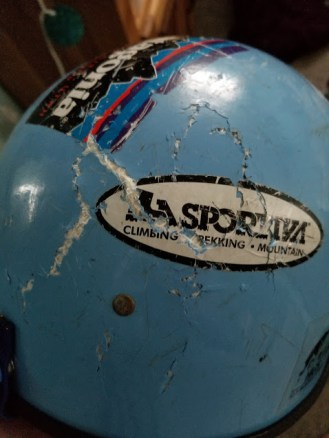
20171221_083850Jeff cracked his helmet, suffered a serious concussion, and had a small cut to his wrist. Other than that, he was injury free. I was (am) shocked. He walked out (mostly) on his own. I was convinced I had killed my brother with a sub-par belay that day. My world was spinning. Soon after that fear was resolved, I knew I had paralyzed him, after that was resolved too, I was kept up haunted by the scene. Where did it go wrong? What could I have done to have changed it? Did I pressure Jeff to lead before he was ready? Did I give a poor belay? What about when I got him down to me, what should have I done medically? Here we are, nearly a month later, and I still have nightly nightmares about it. Today went to visit Jeff at work, just to say hi. He brought it up, and today was the first time I have talked about it. We both cried.

I can’t explain his experience, or anyone else’s beyond mine. My experience was full of fear, so much so that it made me question if I could really handle it again. Life has some exciting adventures. I feel like I have had more than most. This adventure was exciting, but one I don’t want to repeat. This adventure reminded me how close death is to the people around me, and what that means. Most importantly, it reminded me what my loved ones mean to me.

ice16.jpg

The Grand Teton

Grand Teton

My older brother Mike taught me to explore the wild, find God in nature and be willing to push into the realm of fear. He told me that some of the most defining moments in life are often associated with high levels of fear, even brushing shoulders with death. Maybe it was the reminder of our mortality, or that death helps focus our minds on the real importance of life. I tend to believe that only when the mind is super focused can God really speak to us. It’s only when we clear the clutter of the world can we see the reality of life.

Evelyn, my wife, Jeff, another brother of mine, and I made our way in a cramped car to the climb the Grand Teton on a warm summer day. I had been here before, years before. The mountains were as daunting then as they were this time. That may be one appeal of mountains, they don’t often change much, but we do. From a flat, dull road the peaks tower like gnarly teeth. The bluebird sky draped them in a comfortable hue almost begging for visitors.

20140713_081103Evelyn is a novice climber. She enjoys the sport, mostly enjoys getting to the wilderness I think, but it isn’t a part of her soul. Jeff is a sportler who can pick up on almost any sport easily. Climbing was a focus late in the game for him, but he seemed to pick up on it and excelled beyond beginner quickly. Though not an expert or pro yet, I certainly trust my life in his hands in the backcountry. As a matter of fact, there isn’t anyone I would rather climb with. So when planning this trip, it was a clear choice asking him to come.

We didn’t spend much time in the town, but got right to the Teton park. We stopped by Forest Service offices to get permits and prepare for the long hike in. We started as quickly as we could, enjoying the early morning temperature of the mountains. The smell of the forest was enchanting and took me to another world. I forgot the aches and pains of my knees or poorly fitting backpack as I took in deep breaths and turned my eyes to the canopy. The birds seemed to be the only creatures that didn’t mind our presence, since the only other animals we saw were hikers.

20140713_123024The hike was long, with switchbacks transitioning from forest to grass fields to boulder fields that hid the trail. The packs weighed on our hips and shoulders early on as we marched deeper into the Teton wilderness, leaving the other hikers further behind. As the trees fell behind, the house size boulders dominated the trail while the river ran beside us. The temperature increased as our elevation took breath from our lungs, and we quickly shed layers to keep cool. At one point, Jeff and I even stripped down to jump into the snow and ice fed river. After having my breath taken away, we ate. Taking breaks in an effort to maintain a pace that wouldn’t tap all our climbing strength, we pressed on through the trail that seemed to lengthen. Passing over one field of loose rock, we would find ourselves just at the start of another. The trail raised before us. Even at the point we thought we met the camp, we realized we still had hours to go.
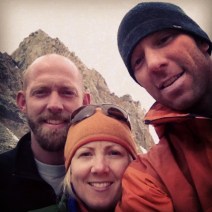
996Finally, we reached the saddle; the slope between the Grand Teton and the Middle Teton. It was a welcomed camp site and we embraced our sleeping bags and pads like long lost lovers. The dried dinners were amazing meals, and we took time to relax, breath, recover and gaze over our accomplishment of the hike. The view was amazing. Society had slipped out of view, mankind was limited to the dozen climbers and Rangers sharing the 100-yard campsite with the marmots who tolerated our invasion. I was there with family, but at times felt alone, but then other times, not alone enough. I am used to climbing solo, and climbing with a party brings new, but mostly welcoming, challenges.

The early climbing morning came and went. We lazily started our trek to the routes we were going to explore before a ranger stopped us. He warned us about the late start and lingering storm that may move in. We thanked him and moved along toward the ragged mountainside. We had a choice, and the guide in me analyzed the risks and benefits. I felt like Evelyn and Jeff saw me as their guide, hoping for a successful summit and safe return. I kept a watchful eye on the storm that was too far off to recognize, and plugged on. I was trying to decide between Owen-Spalding route that is ‘easy’ with uncomplicated retreats, or Exum Ridge that is the traditional, challenging route with limited retreats and big exposure. Once we got to the fork, I chose Exum and the others agreed. The storm was still afar off, without much movement and the barometer hadn’t moved too much for concern. On we went.

20140713_081840I was surprised at the skills that both Evelyn and Jeff showed. We took a comfortable pace as we went one pitch at a time. Passing over the boardwalk, the ledge, crux and on to the staircase, I started to recognize the speed and size of the storm approaching us directly. I picked up the pace, concern filled my veins displacing the acid that pumped through my muscles. We finally got two pitches away from the summit when the blue blanket in the sky was replaced by grey and black anger.
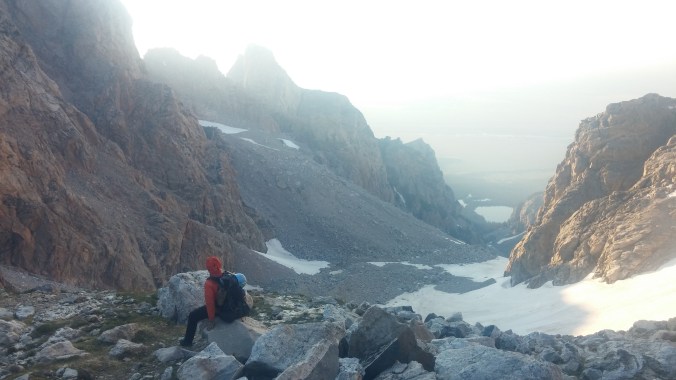
I hiked the pitch faster than I have climbed before as Jeff fought to keep pace on belay. I placed protection what felt like miles apart, but felt solid on the climb, only remembering three or four moves – my mind so focused. This is part of why I climb, this moment. In the hustle and bustle of daily life, we forget too many things about who we are. Nature has a way to refocus the mind and remind us how small we are, how fragile. And yet, it teaches us how significant we are. It teaches us that we are all made of star stuff, and everything is connected. Nature shows us that the cosmic power of the universe is within us, each of us. It is in the moments of pure focus that these lessons come spilling over. Your mind isn’t concerned about the stock market, or the politics of today. It’s not worried about what fight you were just in with a loved one, or that you were locked in traffic for hours just to have someone cut you off. Your mind isn’t thinking about these things in the pure focus of nature, because these things don’t matter. Your mind doesn’t really care. When the mind is totally focused, God has a chance to speak to you; and the only lesson that really matters in all this is LOVE. We are powerful beyond measure, and that power stems from love. That’s the main message God sends me, that’s the center I find again and again in nature. We are all connected, we are all in the hardness of life together, and we all need to love each other more. Nature has unconditional love for me, and teaches me to do better at that in my life with others.

Back to the climb: I reached the top of the pitch, looked down and yelled for my brother and wife to get up here. I could feel the storm. Nothing falling from the sky yet, but I felt the ions beaming in my ears. I knew it was about to get wild. Jeff arrived first, and I shrugged him away to prepare for Evelyn’s arrival. She came up, visually upset, and not sure what to expect. With the rocks humming with electricity and excitement, we shed our gear. I yelled to leave the rope, Jeff yelled to ditch the rest of the gear, his helmet included.

From the time Evelyn got to the top with Jeff and me to the time Jeff ditched his helmet there were two lighting strikes. They came with a haunting warning and blasted a cannon shock in the air leaving my lungs empty from the force of the blast. The light was blinding. The sound was deafening. The punch in the air was crippling.

Descending the side, we found a small rock crop while, it seemed, Thor was trying to take the mountain down. Another blast, then another. The rocks hummed just before the lightning strike, the hairs in my beard stood on end and my ears buzzed… then… the sky lit up, a blast pushed me to the rocky mountainside and it started to snow. Midsummer, just hours before with the sun on our faces, we now crouched between to wet rocks wondering if the God of Thunder would find us. Hiding, we prayed. I remember not praying for salvation, but hoping for it no doubt. I remember giving thanks. Not only for the magnificent days we had here, the awe-inspiring climb, the safe passage to this point, the family with us and the love we felt – but also thanks for all the moments in life that lead us to this point, good and bad. We expressed how grateful we were, how much we loved what we had, and how much we loved each other and the other family we left home.

Jeff shivered, coated in snow. Evelyn leaned against him, tucked her hands in her armpits and closed her eyes. I looked up and saw the blanket of blue again. I had the feeling that it wasn’t the mountain trying to end us, it was nature reminding us how powerful it is, how impressive it is, and how much we need to respect it. It was the universe reminding me, no matter how awful it gets, no matter how scary, there’s always a blue blanket of love there, and no matter what, it’s going to be ok.

We stepped out of the cropping. I was thrilled. We found our way down and lazily made our way back to the camp. Sitting there, we looked over the valley and horizon with gratitude and love.20140713_123648

Mike once wrote, “In climbing there is absolute simplicity and undisturbed focus that opens channels in the soul which allows it to be filled with an overwhelming sense of life around you, and overwhelming sense of God. I doubt there is any other way to produce such emotion – I suppose that is why mountains have always served important functions in the religion of humankind. I feel very blessed to have the opportunities that I have been given to climb. I think sometimes it’s difficult for others to understand – but for me – it is simply a way of life.”

20140713_062521

Star Stuff

For several years of my young adult life, I lived in Dresden, in what used to be East Germany.

dresden

This city was decimated during WWII, and people still wonder whether the bombing by the British was entirely strategic, or partly in retaliation for the levelling of several British cities by the Germans. Coventry was one of those cities, with beautiful cathedrals that were turned to rubble by German bombers. In Germany, after the destruction, the people of Dresden walked past the remains of their beloved Frauenkirche for 60 years, and finally must have given up hope that it could ever be whole again. But while I was there, in 2000, construction began, and now there is a beautiful church there that is a wonderful replica of the original.

Among the donations to the reconstruction of the Frauenkirche, many came from the people of Coventry, who understood the German people’s pain. Finally, the cross that would crown the building was made by the son of one of the British bombers, from nails retrieved out of the destroyed Coventry cathedral.

Not only is this an allegory about finding enough hope to make ourselves whole again, but it is about hope coming from unlikely sources and in unexpected ways.

Every day, after a long shift in the Emergency Room, I sit down at my desk to dictate, write or to read. I plop myself into my chair, clear aside enough clutter from the desk to fit my laptop, push a few boxes out of the way and begin my work. With incoming climbing magazines, medical provider journals, and masonic books, handouts or articles, I lovingly look at the covers and, not ready to throw them away quite yet, but not having time yet to read them, I balance them on top of the dozens of others (still in their plastic wraps) and loose another few inches of office space. Gradually, my movement becomes more and more restricted as I paint myself into a corner of free space till I finally reach a tipping point; I have to fight back.

I declare a clear desk policy and pounce on the chaos, determined to beat it into submission. I banish some scribbled notes to recycling; then I shuffle a few items over to a different pile behind my chair, to file later; but that stack of pads and post-it-note might have useful information, and I don’t have time to decide right now what is vital. So I end up reclaiming maybe half of my desk, and leaving the other half for another day and another battle.

It’s uncomfortable to live this way – constantly reminded of all the things that need doing, by the pieces of paper and books and letters scattered around. It’s like buying a house, and living in one room of it while the rest is used for storage. Why don’t I just sweep through the office until it is all in order, and then keep it that way? But it would take too long to sweep through (I never have the time), and I don’t have the system to keep it in order afterwards.

It’s a metaphor for living inside an imperfect person. Our faults are irritating, and they reduce our efficiency. We wish that we could clean them all up once and for all, but even if we could wipe it all clean, we’d be back with a mess in a few days. It’s not a question of whether we have a messy office – everyone’s life is imperfect and messy – and it’s not just a question of hanging in there until we figure out how to tidy it; we simply can’t be hanging on, ignoring the mess, for the next few eons. As pressing as the question is regarding how to make things tidy, it is even more urgent that we figure out how to live with the disarray without losing our sanity.

We all know that we need to feel a little uncomfortable about our imperfections and shortcomings in order to motivate us to improve. But if the pain of imperfection engulfs the little flame of hope that keeps us moving, we are liable to just roll over give up.

We are all less than perfect – in fact we are all pretty much at the same stage in our quest for becoming the perfect ashlar – and our shortcomings are bound to bring us a bit of misery. But there must be just the right amount of irritation to highlight our faults without overwhelming us. When an oyster encounters a grain of sand, it ever so slowly turns it into a beautiful pearl. But if 1000 grains of sand bombarded it, maybe it would just throw in the towel.

Every day we wake up a different person than we were yesterday; our body has replaced or added several billion cells in the past few hours; our brain has developed millions of new neuron pathways; it no longer thinks the same way; we have a different perspective from the one we had just minutes ago. And yet we treat ourselves as if we have arrived; despite the fact that our opinion has changed several hundred thousand times, we are absolutely sure that we are now correct, that our current perspective is the only true one, and the whatever label we give ourselves right now is who we are. But today’s selfie is not who we are, who we are remains to be seen.

In fact we are billions of years old. Since before the solar system came into being we have been trying to emulate the Grand Architect, or at least Godly attributes. I like to imagine that we have been going to character building summer camps and galaxy design classes, and who knows what. And here we are – still getting angry at the guy who cuts in front of us on the highway. We’ve had billions of years to become better people, and we’ve still not made it. Maybe we are expecting too much of ourselves to become perfect in a few decades.

Even worse – after watching too many sitcoms, we expect everything to be solved in 30 minutes. As our life movie rolls on, and frame after frame shows no improvement, like the rubble in Dresden, we see no possible path from a ruin to a beautiful monument. When we become convinced that there can’t possibly be a happy ending, how do we hold onto the hope of a better self?

As Ishmael says in Moby Dick: ‘we are all cracked in the head, and badly in need of fixing’. We are all pitiful sheep and have lost our way in one thing or another. Each of us needs continual rescuing, and it is our job, as brothers, to rescue each other when and where we can. Beyond the next degree, the color of the ribbon we wear, the secret knowledge we think we obtained, the superiority we believe we hold, our motto as a brotherhood must be: to do all the good we can, by all the means we can, in all the ways we can, in all the places we can, at all the times we can, to all the people we can. And that we intend to do so for as long as we can! Remembering that we are endowed with a competency of His divine wisdom and power.

Surely… if man can take the ruins, rubble and remains of a broken city and rebuild an awe-inspiring structure that rises towards the heavens, how much more capable is the Father of the Universe to restore His children who feel broken or destroyed? I assure you, there is no life so shattered that it cannot be restored, no position of the fraternity that cannot be rebuilt or remodeled.

We, each one of us, need to take up the builder’s tools and get to work. We must extend our hands to one another and help our brother shine, rejoicing in his success. Our lost brethren can be reclaimed, our future brethren can be recruited, our fraternity can be restored. But these rescuing efforts may go on for a long long time. But there is no greater work than the efforts we put forth for our brethren.

In the seventeenth chapter of St. Luke, it is written “the kingdom of God is within man”. I dare say that this kingdom is neither in one man nor a group of men, but in all men. In you. And in me. We, as the people have the power, the power to create happiness, the power to make this life free and beautiful, to make this life a wonderful adventure, most of all to show the kind love of the Grand Master of the Universe.

Neil Tyson deGrasse, astrophysicist and cosmologist, once said,

“The most astounding fact is the knowledge that the atoms that comprise life on Earth, the atoms that make up the human body, are traceable to the crucibles that cooked light elements into heavy elements in their core under extreme temperatures and pressures.

starstuff

These stars, the high mass ones among them, went unstable in their later years. They collapsed and then exploded, scattering their enriched guts across the galaxy. Guts made of carbon, nitrogen, oxygen and all the fundamental ingredients of life itself.

These ingredients become part of gas clouds that condense, collapse, form the next generation of solar systems, stars with orbiting planets. And those planets now have the ingredients for life itself.

So that when I look up at the night sky and I know that yes, we are part of this universe, we are in this universe, but perhaps more important than both of those facts is that the universe is in us. When I reflect on that fact, I look up—many people feel small because they’re small and the universe is big—but I feel big, because my atoms came from those stars. There’s a level of connectivity.

That’s really what you want in life, you want to feel connected, you want to feel relevant, you want to feel like you’re a participant in the goings-on of activities and events around you. That’s precisely what we are, just by being alive.” https://www.youtube.com/watch?v=9D05ej8u-gU

That is precisely what we are, by being together.

We are all connected, we are all relevant. Humans seek opportunity to frequently feel that and be active participants in the great workings around us. One of the great truths taught within the walls of love and truth is that we are not stuck with the nature we were born with. We can change and transform ourselves into better men, just as we can change our surroundings.